Krishna G.
Palepu
is the Ross Graham Walker Professor of Business Administration
and has served previously as Senior Advisor to the President of Harvard University, and Senior Associate Dean at the Harvard Business School.

Professor Palepu’s current research and teaching activities focus on strategy and governance. Professor Palepu has published numerous academic and practitioner-oriented articles and case studies on these issues.
In the area of strategy, his recent focus has been on the globalization of emerging markets, particularly India and China, and the resulting opportunities and challenges for western investors and multinationals, and for local companies with global aspirations. He is a coauthor of the book on this topic, Winning in Emerging Markets: A Road Map for Strategy and Execution. Professor Palepu Chairs the HBS executive education programs, “Global CEO Program for China” (3 weeks), “Leading Global Businesses” (1 week), and “Senior Executive Leadership Program—India” (7 weeks).
In the area of corporate governance, Professor Palepu’s work focuses on board engagement with strategy. Professor Palepu teaches in several HBS executive education programs aimed at members of corporate boards: “Making Corporate Boards More Effective,” “Audit Committees in a New Era of Governance,” and “Compensation Committees: New Challenges, New Solutions.”
In his prior work, Professor Palepu worked on mergers and acquisitions and corporate disclosure. Based on this work, he coauthored the book, Business Analysis and Valuation Using Financial Statements: Text and Cases, which won the American Accounting Association’s Wildman Award for its impact on management practice, as well as the Notable Contribution to the Accounting Literature Award for its impact on academic research. This book, translated into Chinese, Japanese, and Spanish, is widely used in leading MBA programs all over the world. It is accompanied by a business analysis and valuation software model published by the Harvard Business School Publishing Company.
Professor Palepu has served on a number of public company and non-profit Boards. He has also been on the Editorial Boards of leading academic journals, and has served as a consultant to a wide variety of businesses. Krishna Palepu is a researcher at the National Bureau of Economic Research (NBER) and a fellow of the International Academy of Management.
Professor Palepu has a masters degree in physics from Andhra University, a post-graduate diploma in management from the Indian Institute of Management Calcutta, a doctorate in management from the Massachusetts Institute of Technology, and an honorary doctorate from the Helsinki School of Economics and Business Administration. Professor Palepu received the Distinguished Alumnus award from the Indian Institute of Management Calcutta.
Featured Work
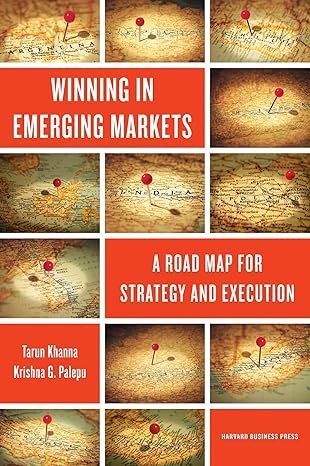
Winning in Emerging Markets: A Road Map for Strategy and Execution
Already cited by the Financial Times, Forbes.com, The Economic Times, WSJ/Mint and several other prominent global business publications, Winning in Emerging Markets is quickly becoming the go-to book for mapping a strategy for entering new markets and then quickly gaining a competitive edge in those high growth regions. Advancing the discussion about emerging markets themselves and how organizations can best leverage the potential of these regions, Tarun Khanna and Krishna Palepu both well-respected thinkers on the subject argue there is more to sizing up these markets than just evaluating data points related to size, population, and growth potential. In fact, they say the possibility to expand a company’s progress in developing economies is to first asses the area’s lack of institutional infrastructure and then to formulate strategies around what the authors call institutional voids” to the firm’s advantage. Khanna and Palepu say the primary exploitable characteristic of an emerging market are such voids, and though they create challenges, they also provide major opportunity both for multinationals and local contenders. Winning in Emerging Markets serves as a playbook for measuring a market’s potential and for crafting a strategy to succeed there.
To learn more, click here.

Business Analysis and Valuation: Using Financial Statements, Text and Cases
This book provides a framework for business analysis and has been used by business schools throughout the world. It provides a foundation for analysis using four key steps: 1) Strategy analysis: Identifying a firm’s strategy and understanding sources of its competitive advantage; 2) Accounting analysis: Assessing how a firm’s financial statements reflect its economics and determining whether any adjustments are needed. This new edition (5th ed) specifically covers measurement questions for firms reporting under US GAAP and International Standards; 3) Financial analysis: Evaluating a firm’s performance using ratios and cash flow data; and 4) Forecasting future performance and estimating its value. These steps are applied to a variety of business contexts, including securities analysis, credit analysis, merger & acquisition decisions, and governance. The book includes a broad range of classic and new HBS cases to illustrate the concepts and applications.
To learn more, click here.
Publications and
Scholarly Contributions
Khanna, Tarun, and Krishna G. Palepu
- World Financial Review
- 2011
Khanna, Tarun, Joe Kogan, and Krishna G. Palepu
- Review of Economics and Statistics
- 2006
Khanna, Tarun, and Krishna G. Palepu
- Harvard Business Review
- 2006
Khanna, Tarun, Krishna G. Palepu, and Jayant Sinha
- Harvard Business Review
- 2005
Khanna, Tarun, and Krishna G. Palepu
- Journal of International Business Studies
- 2004
Khanna, Tarun, Krishna G. Palepu, and Suraj Srinivasan
- Journal of Accounting Research
- 2004
Kaplan, Robert S., and Krishna G. Palepu
- Harvard Business Review
- 2003
Teaching Initiatives
Preparing to Be a Corporate Director
Preparing to Be a Corporate Director
What does it take to succeed as a corporate director? For senior executives interested in joining a corporate board, preparation is key.
Preparing to be a Corporate Director dives into the unique responsibilities, dynamics, risks, and opportunities of joining a corporate board. You’ll gain critical tools and insights that enhance your readiness for corporate board service and your ability to make a lasting contribution at the highest level of an organization.
Value Creation Through Effective Boards
Corporate boards can have a significant impact on value creation, but directors must first optimize how they’re structured and governed.
Value Creation through Effective Boards (developed and taught in collaboration with the IESE Business School, University of Navarra) examines the strategic and organizational issues facing corporate boards of directors. With greater insight into corporate governance oversight and best practices, you’ll be prepared to enhance your contribution as a board member and create more value for your company.
Advanced Management Program
Market volatility, digital transformation, and automation are changing the way companies compete in every industry. The demand for business leaders who can create continuity and growth at a global level is higher than ever.
Designed to spark self-reflection, innovation, and collaboration, the Advanced Management Program is both a highly structured and deeply personal learning experience. This program empowers established senior leaders to steer full-scale change for their organizations.
Senior Executive Leadership Program—India
India is one of the fastest-growing economies in the world. To seize opportunities and sustain success under shifting global business conditions, executives need to be confident decision-makers, skilled strategists, global thinkers, and effective change agents. The Senior Executive Leadership Program—India empowers you to look critically at your business as a whole and make the bold moves that foster growth. After attending a series of modules in Boston and Mumbai, you’ll leave ready to take your leadership skills and your career to the next level.
Leading Global Businesses
In an increasingly complex and volatile global world, companies need leaders with a unique mix of global business skills and personal leadership strengths.
Leading Global Businesses will help you develop both your global intelligence and your personal effectiveness in leading a global business. You will learn how to create and sustain global competitive advantage for your company, adapt business strategies and operations to the rapidly changing global environment, and build global leadership capacity throughout your organization. You will also embark on a profoundly personal exploration that builds your self-awareness and emotional intelligence, delving into the core of your experience to strengthen your capacities as a global leader.
Value Creation Through Effective Boards
Advanced Management Program
Senior Executive Leadership Program—India
Leading Global Businesses
Awards & Honors

2021
Case Centre Award
in the Production and Operations Management category for “Ant Financial (A)” with Feng Zhu, Ying Zhang, Anthony K. Woo, and Nancy Hua Dai (HBS Case 617-060).
2020
Recipient
of the Distinguished Alumnus Award from the Indian Institute of Management
2020
Recipient
of the Distinguished Alumnus Award from the Indian Institute of Management
2013
Elected
a Fellow of the International Academy of Management
2001
Winner
All Star Paper Award from the Journal of Financial Economics for "Does Corporate Performance Improve after Mergers?" (April 1992) with Paul M. Healy and Richard S. Ruback.